Procuring Services from Foreign Providers – 6% Tax

Adapted from article by Thenesh Kannaa, AT-mia.my

1 January 2019 didn’t just mark the first day of 2019, but also the requirement for Malaysian businesses to self-account for 6% service tax upon procuring certain services from foreign service providers. This requirement applies even to Malaysian businesses that are not service tax registered.

Why this new requirement?

2018 was a year of unprecedented changes for Malaysia vis-à-vis the political front as well as taxation, particularly indirect taxation. Goods and Services Tax (GST) was reduced to zero per cent effective 1 June 2018 and formally repealed effective 1 September 2018.

Following the three-month tax holiday period, Sales Tax and Service Tax (SST) was implemented effective 1 September 2018.

One of the key differences between GST and SST is that SST is a single-stage taxation, which means that businesses that incur SST on their acquisition are generally not eligible for a credit of the SST incurred on their costs/acquisitions.

As a result, businesses would prefer to acquire goods and services without SST to keep the costs low (there’s no compelling reason for such preference in the GST regime given that businesses are generally granted an input tax credit in respect of any GST incurred on acquisition).

Hence, during the period 1 September 2018 to 31 December 2018, Malaysian service providers were arguably at a disadvantage as they had to charge 6% service tax to their customers on provision of taxable services. However, these customers would not incur any service tax if they had purchased the same service from a foreign provider. This inequality is illustrated in Diagram 1 below.
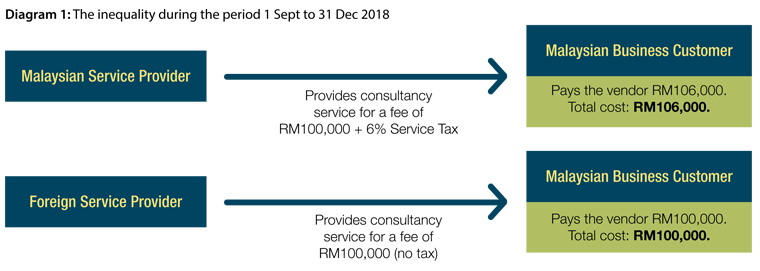
As illustrated in Diagram 1, the Malaysian service provider is required to charge 6% service tax but the foreign service provider, which does not have any establishment in Malaysia, is not required to charge service tax.

Given that no input tax credit is available under the SST regime, the Malaysian business customer would prefer to acquire the services from a foreign service provider. To avoid such bias and any potential serious consequences in the long run, the imported services tax was introduced effective 1 January 2019.

The concept of imported services tax

Imported taxable service is defined in the Service Tax Act 2018 (as amended) as any taxable service acquired by any person in Malaysia from any person who is outside Malaysia. The three key phrases in the definition are further explained in Table 1 below.
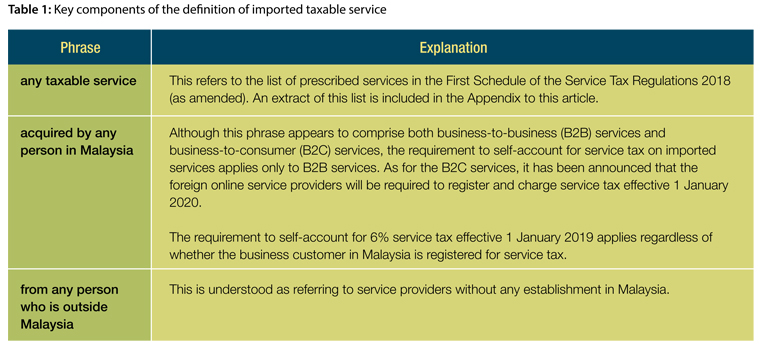
The reverse charge mechanism during the GST era were limited to situations where the services are consumed in Malaysia. There’s no express provision that limits application of imported service tax based on place of consumption. However, Customs has recently expressed its interpretation that accommodation in a hotel overseas is not an imported service, and hence not subject to imported service tax. No detailed reasoning was offered to support the interpretation and hence the criteria used by Customs to determine whether or not a service is being “imported” is yet to be known.

Continue reading: https://www.at-mia.my/2019/02/15/procuring-service-from-foreign-providers-heres-an-additional-6-tax/


Digital Service Tax

The government has fixed 6% as the rate for the digital service tax it wants to implement from Jan 1, 2020, with the threshold set at RM500,000.

The Service Tax (Amendment) Bill 2019, allowing for the imposition of the digital tax, was passed by the Dewan Rakyat yesterday.

In his winding-up speech on the bill, Deputy Finance Minister Datuk Amiruddin Hamzah said the 6% rate was relatively low, pointing out that Norway, for instance, had been imposing a rate of 25% since July 2011.

Elsewhere, he said New Zealand introduced a 15% digital tax in October 2016, and Russia an 18% tax in January 2017.

Putrajaya proposed the digital tax when presenting Budget 2019 last November, saying it would be imposed on foreign digital services, including software, music, video and digital advertising.

Amiruddin said the tax was proposed as it was unfair that only local digital service providers were required to pay tax but foreign providers were exempted.

“The digital tax is to provide a level playing field among local and foreign companies, as well as between online and offline service providers,” he said.

He expressed confidence that foreign providers would comply as they would want to safeguard their image.

Under the bill, tax defaulters can be fined up to RM50,000, imprisoned for a term of up to three years, or both, upon conviction.

The proposed law is applicable to any person, of whatever nationality or citizenship, beyond the geographical limits and the territorial waters of Malaysia, if the person is a foreign service provider.

The bill defines a foreign service provider as any person who is outside of Malaysia providing any digital service to a consumer. It includes any person who is outside Malaysia operating an online platform for buying and selling goods or providing services (whether or not such person provides any digital service).

Digital service, meanwhile, is defined as any service that is delivered or subscribed over the Internet and other electronic network and which cannot be obtained without the use of information technology and where the delivery of the service is essentially automated.

Amiruddin said with government-to-government cooperation, Putrajaya would be able to enforce the law even if the digital service providers were in other countries .

“This cooperation enables us to take legal action against foreign companies which refuse to pay the service tax,” he said.

Pangkor set to be duty-free zone

The Dewan Rakyat yesterday also passed four other amendment bills tabled by the ministry of finance. They were the Free Zones (Amendment) Bill, Customs (Amendment) Bill, Excise (Amendment) Bill and Sales Tax (Amendment) Bill.

Under the Free Zones (Amendment) Bill, Pangkor Island in Perak will join Langkawi, Labuan and Tioman as duty-free zones.

There were also amendments for 18 clauses, including provision of more deterrent penalties to prevent the misuse and manipulation of facilities and customs procedures in the free zone.

The bill also sought to amend Section 10A of the Free Zone Act 1990 to require every person to preserve for a period of seven years all documents and records relating to the activity of importation, exportation or manufacturing of goods in the free zone.

The Customs (Amendment) Bill, meanwhile, is mainly aimed at improving customs procedures relating to, among others, the payment of customs duty, surcharge, penalty and fee.

The bill underlines that for assets seized by the customs department, maintenance fee can be claimed from the asset owner.

It should be noted that among assets that have been previously brought under the custody of the customs department was the mega yacht Equanimity owned by controversial businessman Low Taek Jho, or better known as Jho Low.

The custody was later given to the High Court, with the government bearing RM14.22 million in costs for maintenance, repair, fuel, legal fees and insurance between August 2018 and end-March this year.

For the Excise (Amendment) 2019 Bill, the main purpose of the amendment is to improve excise procedures relating to the payment of excise duty, obligation to keep records and warehousing of imported goods.

“The amendment also seeks to strengthen the enforcement powers of the officers of excise, and to increase the amount of penalty for offences under the Excise Act 1976,” the bill read.

The Sales Tax (Amendment) 2019 Bill sought to make 10 amendments, which included providing clarity to the meaning of the term “manufacture” involving petroleum products and to empower the director-general to approve sales tax deduction applications.